

3D Meat Printing: A New Era of Food Production
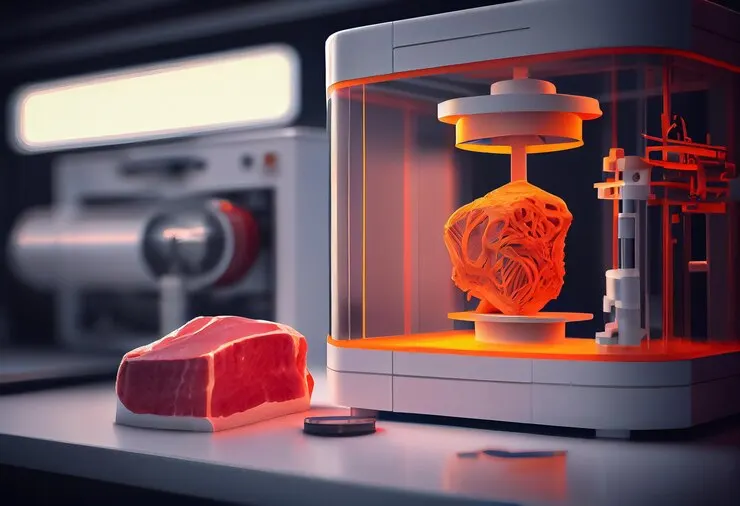
3D meat printing builds a cut of meat layer by layer, using either cultured animal cells or plant proteins as the ink. It is real technology and it is sold in a small number of countries, but it is expensive and still nowhere near supermarket scale. Almost everything you can buy today is moulded plant protein rather than printed animal cells.
Two quite different things get lumped together under the label. Cultured meat grows animal cells in a bioreactor. Plant-based printing extrudes protein pastes into fibre-like layers meant to behave like whole cuts of meat. A few companies do both. Where a claim below applies to only one of them, it says so.
How 3D meat printing works
The cell-based route involves several steps. Plant-based printing skips the first two and starts at the printer.
MindShift Mentors · 7 nights free
It’s 9pm and you’re not even hungry
The kitchen light goes on anyway. Fifteen minutes of guided audio a night, aimed at the pattern rather than the willpower.
Try 7 nights freeThat’s me, most nights1. Cell culture
- Cell isolation: animal cells, such as muscle, fat or connective tissue cells, are taken from livestock, usually by biopsy.
- Cell proliferation: those cells are grown in a nutrient-rich medium so they multiply.
- Cell differentiation: the cells are prompted to become specific tissue types, such as muscle or fat.
2. Bio-ink creation
- Cell suspension: the cultured cells are suspended in a bio-ink, a gel-like substance that gives structure and support.
- Biomaterial selection: the bio-ink uses biocompatible materials such as collagen, fibrin or alginate, which stand in for the extracellular matrix.
- Ink formulation: the mix is tuned for cell viability, printability and tissue formation.
3. 3D printing
- The printer: a specialised 3D bioprinter deposits the ink layer by layer. Plant-based printers use a similar head with protein and fat pastes instead of cells.
- Printing techniques: extrusion and inkjet methods are both used, depending on how fine the structure needs to be.
- Scaffold design: the printer follows a digital file to build the shape, whether that is a steak, a patty or a sausage.
4. Maturation
- Tissue engineering: cell-based prints are matured in a bioreactor so the tissue can develop.
- Nutrient supply: the bioreactor holds a controlled environment with nutrients and growth factors.
- Maturation time: this stage can take weeks, depending on the product.
Plant-based prints need none of this. They go straight from the printer to chilling, packing and cooking, which is a large part of why they reached the market first.

What does 3D printed meat cost?
It is still expensive, though far less than it was. The first cultured beef burger, made public in 2013, reportedly cost somewhere around USD 300,000 to produce as a one-off research project. Costs have fallen sharply since, but they have not reached parity with farmed meat.
Growth media, the liquid the cells feed on, is the single biggest line item in cell-based production and is generally reported to account for the majority of the cost. For plant-based 3D printing, the costs sit in equipment and protein ingredients instead, and startup cost estimates for a small 3D printed vegan meat business are typically quoted in the range of $50,000 to $500,000.
Will it get cheaper?
Probably, though nobody can put a firm date on it. Two areas are moving. The first is cheaper inputs, including edible plant-based inks made from food industry by-products such as cereal husks, which are inexpensive and can be absorbed into the product. The second is process engineering: faster print heads, better media recycling and more efficient supply chains. Whether that adds up to shelf prices matching mince is still an open question.
Is 3D printed meat better for the environment?
On the available evidence, yes, though the size of the gain depends heavily on which technology you mean and how the electricity is generated.
Livestock farming is a genuinely large emitter. The most widely cited FAO estimate puts it at roughly 14.5 per cent of global greenhouse gas emissions, mostly methane from cattle plus feed production and land clearing. More recent FAO work revises that figure downward, but it remains a substantial share whichever number you use.
Conventional beef is also water and land hungry. Commonly quoted figures put beef at around 1,800 gallons of water per pound (roughly 15,000 litres per kilogram), and grazing plus feed crops take up a large share of global agricultural land.
Life cycle assessments of plant-based meat alternatives report large reductions against beef, in the range of up to about 90 per cent fewer greenhouse gas emissions, up to 99 per cent less water and up to 95 per cent less land. Those are best-case comparisons against beef specifically, and the gap narrows against chicken or pork. Cultured meat is harder to assess, because the published estimates depend on assumptions about future energy use in bioreactors that have not been tested at scale.
The pollution picture follows the same pattern. Intensive livestock farming is a significant source of ammonia, nitrate and phosphorus run-off, and processes that do not involve herds of animals produce far less of it.
Where is 3D printed meat legal?
The regulatory picture has changed quickly and differs by country, so check before you assume anything.
Singapore was the first country to approve the sale of cultured meat, clearing Eat Just’s cultured chicken in December 2020. The United States followed: the FDA completed pre-market safety consultations and, in mid-2023, the USDA granted label approvals allowing Upside Foods and Good Meat to sell cultured chicken, which then appeared on a small number of restaurant menus. Israel has since approved cultured beef. Approvals elsewhere, including Australia and New Zealand, have moved through food standards processes on their own timelines.
In the United States, oversight is shared. The FDA handles cell collection, banking and growth, then hands over to the USDA’s Food Safety and Inspection Service for harvest, processing and labelling. Products must comply with the Federal Food, Drug, and Cosmetic Act. Plant-based printed products are regulated as ordinary foods and face no such special pathway, which is another reason they got to market first.
Nutrition and consumer questions
Printing gives manufacturers unusually fine control over what goes into a product. In principle that means fat content, fat type and added nutrients can be dialled in, and cell-based production does not require the antibiotics used in some livestock systems. What it does not mean is that a printed product is automatically better for you than a farmed one. These are processed foods, salt and fat levels vary widely between brands, and long-term nutrition research on them is thin. Read the panel on the pack rather than the marketing.
Taste and texture
This is the most common objection and the most legitimate one. Companies including Redefine Meat and Novameat have built their whole pitch on printing muscle-like fibre structure rather than mincing everything, and blind tastings have produced some good results. Whole-muscle cuts remain the hardest thing to imitate.
Cost
High production costs are still the main barrier. Until scale brings prices near conventional meat, these products stay a premium category.
Confusion with GMOs
3D printed meat is not the same thing as genetic modification. It is produced from cell cultures or plant proteins. Some ingredients used in the sector, such as the soy leghemoglobin in Impossible products, are made using genetically engineered yeast, so if that matters to you it is worth checking the specific product.
The global landscape
United States
The US hosts several of the best known cell-based companies, including Upside Foods (formerly Memphis Meats), Eat Just and Finless Foods. All have raised substantial venture funding and hold regulatory clearances or applications for cultured products.
Netherlands
The Netherlands has been central to cultured meat since the beginning. Mark Post, at Maastricht University, unveiled the world’s first lab-grown burger in 2013 and went on to co-found Mosa Meat, which is still one of the field’s leading companies.
Israel
Israel has an outsized alternative protein sector for its size, backed by strong government research funding. Notable companies include Aleph Farms, SuperMeat, Steakholder Foods (formerly MeaTech) and Believer Meats (formerly Future Meat Technologies). Steakholder Foods in particular works directly on 3D printing rather than only cell culture.
Singapore
Singapore became the first country to allow cultured meat to be sold and has continued to position itself as a testing ground for alternative proteins, largely because it imports most of its food and treats supply security as a policy priority.
Notable companies and what they actually make
A note on terminology: not every company in this space prints anything. Some are cultured meat companies, some are plant-based manufacturers using extrusion, and only a few use true 3D printing.
Impossible Foods
- Plant-based, not printed. The Impossible Burger uses soy leghemoglobin, or heme, to mimic the taste and juiciness of beef.
- Distribution runs to tens of thousands of grocery and foodservice outlets across its markets.
- The range has expanded into sausage, mince and hot dogs, with the hot dogs marketed on lower total and saturated fat than a typical beef equivalent.
- The company publishes life cycle figures claiming large reductions in emissions, water and land use against beef.
Beyond Meat
- Also plant-based rather than printed. The fourth-generation Beyond Burger reformulated around avocado oil to cut saturated fat.
- Beyond Beef is built on peas, brown rice, red lentils and faba beans.
- Sold through tens of thousands of grocery and foodservice locations, though the company’s sales have been under pressure in recent years.
Upside Foods
- Cultured, not printed. Upside grows meat directly from animal cells rather than raising and slaughtering animals.
- It has produced cultured chicken and, earlier as Memphis Meats, cultured beef and chicken meatballs.
- It holds US regulatory clearance for cultured chicken, though volumes remain very small.
Redefine Meat and Steakholder Foods
- These are the genuine printers. Both build whole-cut analogues by depositing protein and fat layer by layer to create fibre structure, and both target foodservice first.
The future of 3D printed meat
Applications beyond steak
- Seafood: Steakholder Foods and others have demonstrated printed seafood, including eel and white fish analogues, aimed at species under fishing pressure.
- Poultry: cultured chicken is the furthest advanced product category by regulatory approval.
- Plant-based cuts: printing is being used to give plant proteins the grain and bite that mincing cannot.
- Specialised diets: portion, texture and nutrient control is useful for aged care and for people who need modified-texture food.
- Space food: space agencies have run experiments printing food in orbit, on the logic that shelf-stable inputs and an on-demand printer beat carrying finished meals.
Market predictions
Treat market forecasts in this sector with caution, because they come from commercial research firms with differing definitions and they disagree with each other. Published projections put the 3D printed meat market in the low hundreds of millions of US dollars now, growing at a compound annual rate somewhere in the mid-teens through to 2030, with North America and Europe holding most of the current share and Asia Pacific growing fastest. Broader alternative protein forecasts have run into the tens of billions and higher, and several have already been revised down.
Consumer appetite is easier to measure. Australian surveys have consistently found that a large minority of people are actively trying to eat less meat and are open to substitutes, which is the demand these products are chasing. Meat alternative sales spiked during the pandemic and have since flattened, so the long-run trend is still being established.
Ethical considerations and challenges
- Animal welfare: cultured meat is grown from cells and does not require animals to be raised and slaughtered, which is its strongest ethical argument. Some growth media have historically used foetal bovine serum, and moving to animal-free media has been a live issue for the sector.
- Environmental impact: the footprint is lower than beef on current evidence, but the gain depends on clean energy powering the process.
- Regulatory approval: rules differ by country and approvals are slow, expensive and not guaranteed.
- Consumer acceptance: the “yuck factor” is real, and labelling fights over what these products may be called are ongoing.
- Texture: matching a whole muscle cut remains the hardest technical problem.
- Cost: without price parity, the category stays niche.
FAQs
Can 3D printers print meat?
Yes. Food-grade 3D printers deposit either cultured animal cells in a bio-ink or plant protein pastes, layer by layer, to build a product with a meat-like structure. Printed plant-based cuts are already on restaurant menus in several countries. Printed cultured meat is further behind and mostly still at pilot or demonstration scale.
What companies are 3D printing meat?
Redefine Meat and Steakholder Foods are the best known businesses using actual 3D printing for meat analogues. Cultured meat companies such as Upside Foods, Aleph Farms, Believer Meats and Mosa Meat are often grouped with them, but most of those grow tissue rather than print it. Impossible Foods and Beyond Meat are plant-based manufacturers and do not print at all.
Is 3D printed meat healthy?
It depends entirely on the product. Printing allows tight control over fat, salt and added nutrients, and cultured production does not need antibiotics. That does not make any given product a health food. These are processed items with widely varying nutrition panels, and there is not yet long-term research on them. Compare the label against whatever you would otherwise eat.
What are the advantages of 3D printed meat?
The main ones are structure and control. Printing can build the fibre and marbling that mincing and moulding cannot, which is why it is being aimed at steaks and fillets rather than patties. It also allows precise portioning and recipe tuning, and, for cultured versions, removes the need to slaughter animals. Lower land, water and emissions intensity than beef is the other argument.
MindShift Mentors · 7-night free trial
You came here to read. This is the other half.
Veganiac covers the food. The harder half is why some weeks it is effortless and some weeks it falls over by Wednesday. MindShift Mentors helps with the pattern underneath that, from Rob Edmonds, who spent years watching capable people fight themselves over this and lose. Fifteen to twenty minutes of guided audio a night.
Free for seven nights, no credit card, $29.95 a month after. Results vary, and it is designed to sit alongside professional care rather than replace it.
Final thoughts
3D meat printing is a genuine piece of food technology rather than a gimmick, but it sits earlier on the curve than the headlines suggest. Printed plant-based cuts are commercially real and improving. Cultured meat is approved in a handful of countries and produced in tiny volumes at high cost. Both need cheaper inputs, better texture and clearer regulation before they change what most people eat.
The honest position is that this is worth watching rather than waiting for. If you are cutting back on meat now, the plant-based products already in the supermarket will do more than a technology that is still scaling.
- 3d meat print
- 3d print meat