
Are Lemonheads Vegan? A Look at the Ingredients
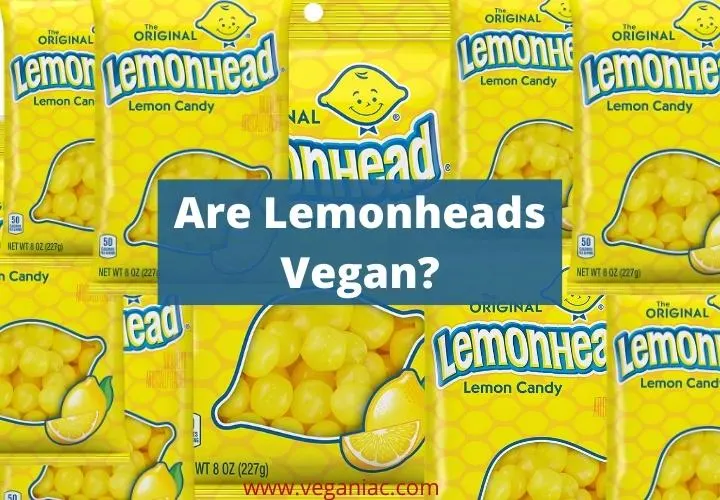
Most Lemonheads are not considered vegan. The sweets are usually coated in confectioner’s glaze, also listed as shellac, which is a resin harvested from lac insects. Formulations differ by country and across the range, so the only reliable check is the ingredient list on the pack in front of you, looking for glaze or shellac.
The Ferrara Candy Company introduced Lemonheads in the 1960s. These sweets are round and fruity, with a sweet outer shell and a hard core. They come in different flavours, such as Appleheads and other fruity varieties, although “Lemonheads” are usually associated with the original lemon flavour.
Are Lemonheads Vegan?
Not by most vegan standards, and this is where people land on different sides of the line. The sticking point is confectioner’s glaze, the shiny coating that keeps the shell hard and glossy. It is insect derived, so a strict reading rules it out, the same way it rules out many other polished sweets. Others treat it the way they treat honey and make their own call, which is why you will see Lemonheads described as vegan or not depending on who is writing.
MindShift Mentors · 7 nights free
It’s 9pm and you’re not even hungry
The kitchen light goes on anyway. Fifteen minutes of guided audio a night, aimed at the pattern rather than the willpower.
Try 7 nights freeThat’s me, most nightsWhat complicates it further is that not every product in the range uses the same recipe. Some varieties and some regional versions leave the glaze out, and recipes are reformulated from time to time without any fanfare. Treat any blanket answer, including one written a year ago, as a starting point rather than the last word on the packet you are holding.
Lemonheads ingredients
To work out whether a product has vegan ingredients, read the ingredient list. The same approach settles most of these questions, whether it is Lemonheads or Airheads. Anything that is not made solely from plant products is generally not suitable for vegans. Below is the sort of list you will find on the original lemon-flavoured sweets, though the exact wording varies by market.
- Modified dietary starch
- Sugar
- Artificial flavours
- Shellac, or food glaze
- Citric acid
- Corn syrup
- Concentrate the lemon juice
Compare that against the pack you have, because the ingredient panel on an Australian import can differ from the American one, and the chewy versions are a different recipe again.
Which ingredients do vegans query?
Confectionery products often contain refined sugar, artificial flavours and artificial colours. None of those are automatically animal derived, but each one has a reason vegans stop and look at it, so they are worth going through one at a time.
Confectionery glaze
Confectionery glaze, or shellac, is animal derived. It comes from a resin secreted by the lac insect, which feeds on tree sap and coats the twigs of the host tree as it goes. Those twigs are harvested, and the resin is scraped, crushed, washed and filtered before it is used on food.
The insects are the problem for most vegans. Enormous numbers of them are involved, with commonly cited figures putting it at roughly 300,000 lac insects per kilogram (2.2 lb) of shellac, and the harvesting and processing kills them. Some producers now market a version they describe as insect-free, but a standard ingredient panel will not tell you which one was used.
The same glaze is used far more widely than most people realise. It is what gives supermarket apples their shine, and it turns up on chocolate coatings, jelly beans, dragees and coated tablets.
Mono and diglycerides and lactic acid can all come from non-animal sources, which makes them less clear-cut. Shellac is always of animal origin.
Where you land on it is an individual decision. This article lists what is in there and offers some alternatives for anyone who would rather skip the glaze entirely.
Artificial flavours
Artificial flavours are made in a lab rather than from animals, so the ingredient itself is not animal derived. The concern is a different one. Flavour ingredients have been tested on animals, historically and in some cases still, which is why plenty of vegans avoid them even though nothing animal ends up in the sweet.
If that matters to you, look for products built on natural or whole-food flavourings instead. There are plenty on the market now that skip artificial flavours and colours altogether.
Refined sugar
Sugar comes mainly from sugar cane and sugar beet. Beet sugar is processed without animal products. Some cane sugar refineries, mostly in the United States, use bone char as a decolourising filter to whiten the sugar, and bone char is made from the charred bones of cattle. The bone char does not end up in the sugar, but it is used to make it, so many vegans avoid cane sugar unless the producer states otherwise.
This is a country-by-country issue. Bone char filtering is not standard practice in Australian sugar refining, but an imported American sweet may well contain sugar that was. Organic and unrefined sugars are not filtered this way. Lemonheads are made with refined sugar and the source is not stated on the pack.
Artificial colours
It helps to keep natural and synthetic colours apart, because the names are confusingly similar. Carmine, also listed as cochineal or Natural Red 4, is made from crushed cochineal insects and is not vegan. Allura Red AC, listed as Red 40 or as additive 129, is a synthetic dye manufactured from petrochemicals, with no animal content.
The same goes for tartrazine (Yellow 5, additive 102) and sunset yellow (Yellow 6, additive 110). Both are synthetic and contain nothing animal derived. Some vegans still avoid them on animal testing grounds, while most vegan certifiers treat them as acceptable.
Share the image below to your Pinterest board and spread the word to other fellow vegans.
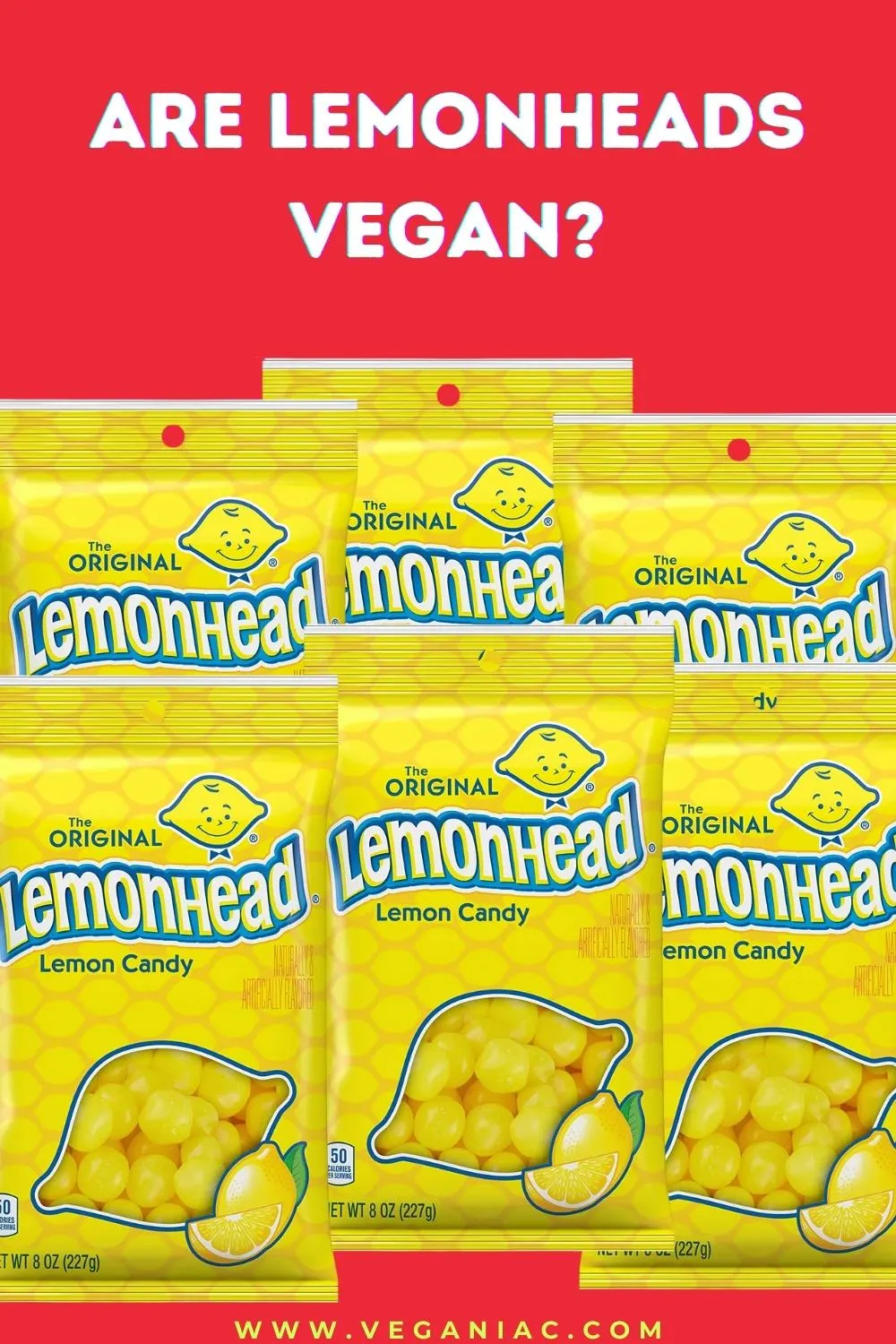
Are Chewy Lemonheads vegan?
Lemonheads are the original hard lemon sweet with a sweet coating and a sour shell. The brand also does Appleheads, Grapeheads and other fruit flavours, which are near-identical products with different flavours and colours. Appleheads list apple juice concentrate with Yellow 5 and Blue 1, and Grapeheads use a mix of Blue 1, Blue 2 and Red 40.
The chewy versions are a separate recipe. They do not use gelatin or egg white for the chew, which is the good news, and they generally rely on gum arabic and other plant-based additives instead. Gum arabic is a tree sap used in soft sweets, icings and fillings, and it helps stop sugar crystallising. Confectioner’s glaze still appears on some chewy varieties, so they are not automatically the safer option.
Chewy Lemonheads also list lactic acid. Commercial lactic acid is almost always produced by bacterial fermentation of sugars from corn or beet, which makes it vegan. It can be fermented on a dairy substrate such as whey, which is why some vegans query it, but that is uncommon in confectionery. If it matters to you, the manufacturer is the only one who can confirm the source.
Lemonhead Alternatives For Vegans
If the glaze rules Lemonheads out for you, there are other lemon sweets that do not use it. These options let you skip animal-derived ingredients without giving up the flavour.
Lemonhead Twists
A lemon-flavoured chew that does not carry the glaze. It does not look or eat quite like the Lemonheads Original, but the flavour is there. The ingredients run to natural flavours, sugar, corn syrup and corn starch.
YumEarth Lemon Organic Hard Candy
This brand is known for making vegan versions of familiar sweets, Lemonheads included. They leave out the ingredients vegans usually query and use organic sugar and natural flavourings, so there is nothing animal derived in them.
Claeys Lemon Drops
These lemon drops taste close to Lemonheads but are less sweet. They are made with natural lemon flavour, corn syrup and sugar, with Yellow 5 for the colour.
Organic hard candies
The brand does plant-based options across a range of fruit flavours. The ingredients are much the same throughout, built on organic sugar, grape colour extract, vegetable juice colour extracts and natural flavours.

Good intentions. Same old habits?
Try a guided audio session for habit change. Press play for 15 to 20 minutes each evening.
One session, free for seven nights. No credit card.
Results vary. Designed to sit alongside professional care rather than replace it.
What should you look for on the label?
Scan the ingredient panel for “confectioner’s glaze”, “confectionery glaze”, “shellac” or additive 904. Any of those means the product is insect derived. Also check for carmine, cochineal or Natural Red 4 in red and pink varieties, and for gelatin in anything chewy. Everything else on a typical Lemonheads panel is plant based or synthetic.
Do Lemonheads sold in Australia have the same ingredients?
Not necessarily. Lemonheads are an American product and what reaches Australian shelves is usually imported, so the panel should match the American one, but importers and distributors can vary and additives are listed by number here rather than by colour name. Recipes are also reformulated periodically. Read the actual pack rather than relying on an ingredient list published online, including this one.
Last words
The reason Lemonheads get ruled out is confectioner’s glaze, an insect-derived coating that appears on most of the range. That is a shellac, not a plant product, so most vegans treat the sweets as off limits, though not every variety and not every market uses it.
Read the ingredient list before you buy, and if the glaze is there, the vegan lemon sweets above will scratch the same itch. Which of these do you reach for instead of Lemonheads?
- Are Lemonheads Vegan
- Are Lemonheads plant-based
- Lemonheads Vegan alternatives
- Vegan lemonheads
- are chewy lemonheads vegan