
Delicious Vegan Custard Easy Recipe
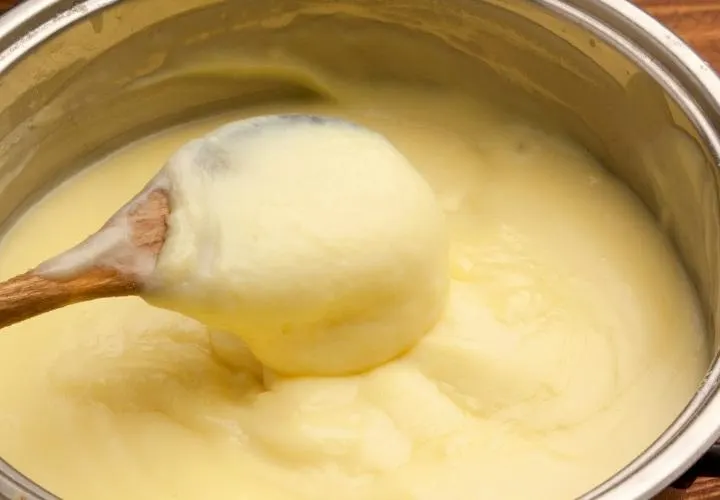
Vegan custard is thickened with cornflour rather than eggs, and it takes about ten minutes on the stovetop. Plant milk, cornflour, sugar and vanilla go into a cold pan together, then come up to a full boil for a minute so the starch sets properly. A pinch of turmeric does the colour that egg yolks would normally do.
This version replaces dairy milk with plant-based milk like soy, almond, coconut, oats, or rice. It works in croissants, cupcakes, donuts and trifles, and the same base takes vanilla, coffee, chocolate or pistachio.
How does cornflour actually thicken custard?
Cornflour granules do nothing in cold liquid. They only swell and burst once the mixture passes about 90°C, which in practice means a genuine boil with bubbles breaking the surface, not just steam. That burst releases the starch. Pull the pan off too early and the custard looks thick in the pan but goes thin and chalky as it cools.
MindShift Mentors · 7 nights free
It’s 9pm and you’re not even hungry
The kitchen light goes on anyway. Fifteen minutes of guided audio a night, aimed at the pattern rather than the willpower.
Try 7 nights freeThat’s me, most nights
Once it has boiled, hold it there for about a minute and then stop, because two things will thin it straight back out:
- Overheating. Boil well past a minute and the swollen granules break down, releasing the water they were holding. The custard loosens and will not come back.
- Over-whisking after thickening. The set comes from a fragile network of swollen starch, and beating it hard once thickened shears that network apart. Whisk constantly on the way up, then stir gently the moment it thickens.
Acid does the same more slowly, which is why lemon custard needs juice folded in at the end rather than boiled with the starch.
Cornflour or custard powder, which should I use?
Custard powder is mostly cornflour with colouring and flavouring added, so it behaves similarly, but the two are not straight swaps.
- Cornflour is pure starch. Strongest thickening per gram, clean flavour, slightly glossy set. You add your own vanilla and colour.
- Custard powder is not pure starch, so gram for gram it thickens a little less. Use roughly a third more, and drop the turmeric and some of the vanilla, since the powder already carries both.
Most classic custard powders contain no dairy, but formulations vary between countries and some add milk powder. Read the tin in front of you.
Ingredients
- Plant-based Milk: 1 ½ cups (375 ml)
- Plant-based cream: 2/3 cup (160 ml)
- Cornflour: 1/3 cup (40 g)
- Sugar: 1/3 cup (70 g)
- Turmeric: 1/8 TSP
- Vanilla extract: 1 TSP
Directions
- Add the plant-based milk, cornflour, sugar, turmeric, and vanilla extract to a cold pot. Whisk until you see no lumps. Starch will not disperse into hot liquid, so this step has to happen cold.
- Turn on the stovetop, and put the pot over medium heat.
- Whisk steadily as it heats. It stays thin, then thickens suddenly. Keep going until it reaches a full boil with bubbles breaking the surface, then boil for one minute.
- Stop whisking hard and switch to slow stirring with a spatula. Run your finger through the coated spatula: the custard is ready if the line holds.
- Turn off the heat, and let the custard cool down to room temperature.
- Once cooled, stir in the plant-based cream gently. Adding it cold and off the heat keeps the set intact.
- Transfer to a bowl, let it cool for 1 or 2 hours, and serve.
Different Flavours of Custard
Pistachios Custard
- Roast about 1.5 ounces (40 g) of pistachios in a pan, then blend them with the plant-based milk.
- Add the pistachio milk, sugar and cornflour to a cold pot and mix well.
- Cook through to a full boil so the starch sets, hold a minute, then cool.
Coffee Custard
- Stir about one and a half tablespoons of instant coffee powder into the plant-based milk.
- Add the remaining ingredients and mix until you see no lumps.
- Cook through to a boil until it thickens. This one works as a topping for donuts or a filling for cakes.
Chocolate Custard
- Add cubes of dark vegan chocolate once the custard has thickened and come off the heat, stirring gently until melted. That keeps it from catching on the base of the pan. Check the label, as dark chocolate is not automatically dairy-free.
Lemon Custard
- Cook a few strips of lemon peel with the custard and lift them out at the end. Add juice only after the custard has thickened and cooled slightly, as acid breaks down the starch and thins the set.

Tired, but your mind won’t switch off?
Try a guided sleep audio session from MindShift Mentors. Listen for 15 to 20 minutes at bedtime.
One session, free for seven nights. No credit card.
Results vary. Designed to sit alongside professional care rather than replace it.
Tips for dairy-free custard
- For a low-fat version, skip the plant cream and increase the milk from 1.5 cups to 2 cups (500 ml). Soy, almond or oat all work.
- Coconut milk, soy cream and rice cream are the ones for a richer, full-fat custard.
- Too much turmeric turns it yellow-greenish and tastes of turmeric, so keep it to a pinch. Saffron works instead.
- Vanilla pods beat extract if you have them.
- Granulated sugar is preferable. Maple syrup suits a less sweet custard, and coconut sugar works but browns the colour.
FAQs
Why does my custard have a strange texture as it cools?
The surface dries out and forms a skin, which breaks into lumps as you stir. Press cling film or baking paper directly onto the surface while it cools and the skin never forms. If lumps have appeared, push the custard through a fine sieve rather than beating it, since beating thins the set.
How do I store vegan custard?
It keeps in the refrigerator for about 2 to 3 days, cooled with the surface covered. To reheat, warm it over low heat with a splash of plant milk, stirring gently. Do not bring it back to the boil, as a second hard boil loosens the starch and thins it.
Can I freeze vegan custard?
Not really. Freezing splits the starch network, and it thaws watery and grainy with a texture you cannot recover. If you have too much, churn it into ice cream instead.
How do I fix lumpy custard?
For a starch custard, lumps are almost always undispersed cornflour or bits of skin. Pass it through a fine sieve while still warm. Avoid the common advice to blitz it in a blender, because that shears the starch and leaves you with smooth but runny custard.
What if my custard becomes runny?
Nine times out of ten it never reached a proper boil. Mix one tablespoon of cornflour with one tablespoon of cold water per cup of custard, stir it in off the heat, then bring it back to a boil for a full minute.
Nutrition Facts
- calories per serving: 150kcal
- Carbohydrates: 13g
- Protein: 1g
- Fat: 9g
Conclusion
That is the whole method: cold start, full boil, one minute, then leave it alone. Get that right and the flavour variations look after themselves. Let us know in the comments how it went.
- Custard vegan
- Dairy-free Custard Recipe
- Easy Vegan Custard Recipe
- Egg-Free Custard Recipe
- How to make Vegan Custard
- Plant-based custard recipe
- Vegan Custard Ingredients
- Vegan Custard Recipe