
Vegan Mochi Donut Recipe
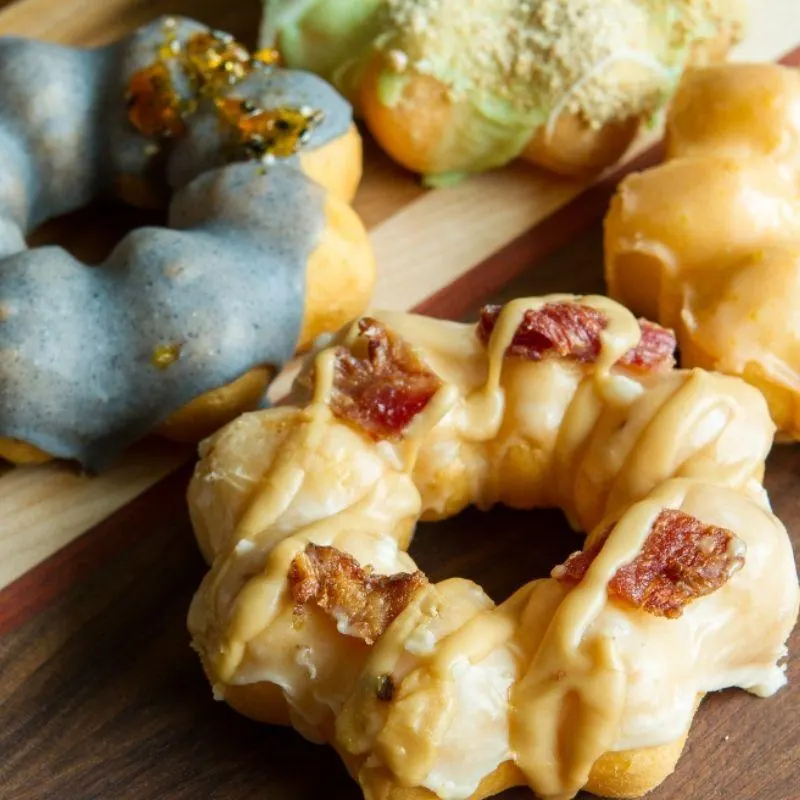
Vegan mochi donuts, or pon de ring, get their chew from glutinous rice flour and tapioca starch rather than wheat. The dough behaves nothing like ordinary doughnut dough. There is no gluten, no yeast and no proving, so you mix it and shape it straight away, and the result is chewy and springy rather than light and bready. Two versions follow.
The shape is part of it. A pon de ring is made from small balls of dough joined into a circle, so it pulls apart in pieces rather than tearing like a wheat doughnut. That style came out of Japan, where mister Donut launched it in the early 2000s, and it has since spread well beyond there.

What makes a mochi donut different?
The difference is in the flour, not the method. A standard doughnut is built on wheat flour, where gluten forms a stretchy network and yeast or baking powder inflates it into an open, bready crumb. Glutinous rice flour has no gluten in it at all, despite the name. What it has is a starch that turns sticky and elastic when it is hydrated and cooked, and that is what gives mochi its pull.
MindShift Mentors · 7 nights free
It’s 9pm and you’re not even hungry
The kitchen light goes on anyway. Fifteen minutes of guided audio a night, aimed at the pattern rather than the willpower.
Try 7 nights freeThat’s me, most nights
Tapioca starch does something similar and is often used alongside it, or on its own, as it is in the first recipe below. Either way the dough is soft, sticky and paste-like rather than kneadable. You will not develop it, you will not prove it, and it will never look like a doughnut dough at any point.
The Dutch brought fried dough to New York as olykoeks, and American doughnuts grew from there. Hanson Gregory, a ship’s captain from Maine, is usually credited with putting the hole in the middle, which he said fixed the problem of the raw, doughy centre. Mochi donuts arrived by a completely different route.
Easy Recipe For Vegan Mochi Donuts:
The first version is baked, uses tapioca flour and coconut yoghurt, and is the simpler of the two. If you have made vegan mochi before, the texture will be familiar.
Ingredients:
For the Donuts:
- 1/4 cup coconut sugar
- 1 tablespoon of baking powder
- 2 cups of Tapioca flour
- 1/2 cup of oat milk
- 1/2 cup of plain unsweetened coconut yoghurt
- 1 tablespoon vanilla extract
- 5 tablespoons of vanilla extract
Note on the list above: vanilla is listed twice and the second entry does not look right. Use the 1 tablespoon and taste the batter before adding any more.
For icing:
- 3 tablespoons of oat milk
- vanilla in the required quantity
- additional colouring of your choice (e.g., spirulina powder or strawberry juice, etc.)
Steps To Prepare Vegan Mochi Donuts
- Preheat the oven to 350°F (175°C).
- In a large mixing bowl, whisk together the ingredients: tapioca flour, coconut sugar, and baking powder.
- Whisk together the coconut yoghurt, oat milk, and vanilla extract in a separate bowl.
- Combining the dry and wet ingredients from both bowls, stir them thoroughly at regular intervals. The mixture will be sticky and heavy rather than smooth, which is normal for this flour.
- Make medium-sized balls with your hands and arrange them in a line on a baking sheet, making sure they are all in the same place and the same order. Press eight balls into a ring so the sides just touch, which is what gives the pon de ring its pull-apart shape. Wet hands stop the dough sticking.
- After that, place the baking tray in the oven, which has already been preheated, and bake for 15 minutes. Later, remove the baking tray from the oven and set it aside to cool completely before frosting.
- Now, let’s get to work on the icing. Mix all the ingredients for the icing according to the directions in the icing ingredients section previously.
- Now that the donuts have cooled, you can begin to decorate them with your favourite toppings, and there you have it.
Second Recipe For Vegan Mochi Donut:
This one uses mochiko, a Japanese sweet rice flour, with cake flour and silken tofu. The tofu replaces the egg and keeps the dough soft. Note that the cake flour means this version is not gluten free.
Ingredients:
FOR THE VEGAN DONUTS:
- extra-virgin olive oil
- 60 grams of sugar
- Baking powder (about 3.1 teaspoons)
- 110 g mochiko rice flour (a Japanese glutinous rice flour)
- Cake flour (110 g)
- 250 g silken tofu
For Glaze:
- 75 g of confectioners’ sugar, powdered
- non-dairy milk (about 1-2 tablespoons) (coconut milk)
- 1/2 teaspoon vanilla extract (optional).
For the matcha glaze, add:
2 teaspoons of matcha of the highest quality.
For the chocolate glaze, add:
- 2 tablespoons of cocoa powder that has been Dutch-processed
- 1/2 teaspoon instant espresso powder (or equivalent).
NOTE: Preparation instructions for the donuts are the same as those given above. Just remember to work in the extra ingredients from this list.
The Glaze Preparation:
- Once the donuts are made, set them aside to cool completely before glazing. Warm glaze on a warm donut runs straight off. Put the icing sugar, non-dairy milk and vanilla in a small bowl and whisk until smooth, adding the milk a little at a time so it does not go too thin.
- Once the donuts are completely cool, dip them in the glaze and set them on a cooling rack to allow the excess glaze to drip off.
- Leave them for 10 minutes or so to set before you stack or serve them.
The Chocolate Glaze Preparation:
- Sift the Dutch-processed cocoa powder and the espresso powder in with the icing sugar so there are no lumps.
- Whisk in the non-dairy milk a teaspoon at a time until the glaze coats the back of a spoon without running off it.
- Dip the cooled donuts, then rest them on a rack and let any sprinkles or toppings go on while the glaze is still tacky.

Tired, but your mind won’t switch off?
Try a guided sleep audio session from MindShift Mentors. Listen for 15 to 20 minutes at bedtime.
One session, free for seven nights. No credit card.
Results vary. Designed to sit alongside professional care rather than replace it.
NOTE: You can use any flavour in the glazing.
FAQs:
- Why does the recipe make such a small batch?
Mochi donuts are best eaten the day they are made, so a small batch is deliberate rather than stingy. Both recipes scale up cleanly if you are feeding a crowd, just keep the ratios the same.
- Is it necessary to use mochiko rice flour in this recipe?
Mochiko is what gives the chew. It is a glutinous rice flour, so it makes the donut springy and dense rather than crisp. Plain rice flour is not a substitute, since it lacks the sticky starch and will bake into something crumbly. Tapioca flour, as used in the first recipe, gives a similar chew and is the usual stand-in.
- What should the temperature of the oil be if I fry them?
Around 170 to 175°C (340 to 350°F). Check with a thermometer if you have one. If you do not, dip the end of a wooden skewer in the oil, and when steady bubbles form around it the temperature is about right. Fried pon de ring puff more and crisp on the outside while staying chewy in the middle.
- What if you are not a fan of frying?
Bake them. Both recipes here are written for the oven, at 350°F (175°C). Baked mochi donuts are chewier and less crisp than fried ones, and they will not puff as dramatically, but they are far less messy.
- What would you do with the donuts once they’re made?
Eat them the same day. Mochi texture firms up and goes tough in the fridge, so if you must keep them, use an airtight container at room temperature and warm them briefly before eating to bring the chew back.
Why is my mochi donut dough so sticky?
Because it is meant to be. Glutinous rice flour and tapioca starch both hold a lot of water and neither forms gluten, so the dough sits somewhere between a thick batter and a paste. Do not fix it by adding more flour, which makes the donuts tough and dry. Wet your hands, or lightly oil them, and the dough will shape without clinging.
Are mochi donuts gluten free?
The first recipe is, since tapioca flour, coconut sugar, oat milk and coconut yoghurt contain no wheat. The second is not, because it uses cake flour alongside the mochiko. Despite the name, glutinous rice flour contains no gluten, the word refers to the sticky texture. If you need these to be coeliac safe, check that your oat milk and baking powder are certified gluten free as well.