

Why Going Vegan Didn’t Make You Happier (And What’s Actually Going On)
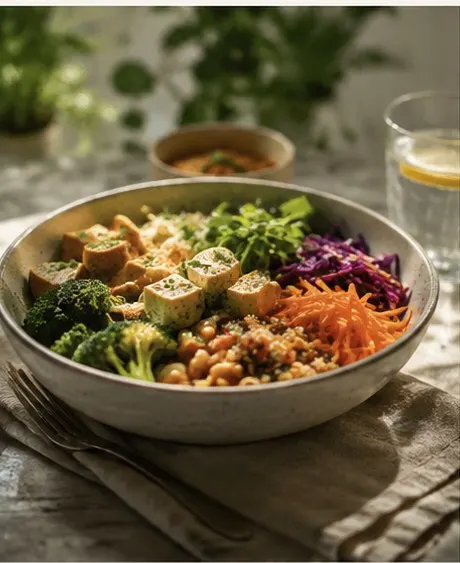
You did everything right. You swapped out meat and dairy. You discovered aquafaba and oat milk and a dozen ways to make tofu taste like something you’d actually crave. You felt the initial glow of making a values-aligned choice.
And then, somewhere around week three, something unexpected crept in. Anxiety. Irritability. A vague sense of deprivation that had nothing to do with food. Maybe even a low-level guilt spiral whenever you slipped up.
If any of that sounds familiar, you’re in the right place. And if you’re looking for plant-based recipes to cook while you read, browse our Recipes for some inspiration.
MindShift Mentors · 7 nights free
It’s 9pm and you’re not even hungry
The kitchen light goes on anyway. Fifteen minutes of guided audio a night, aimed at the pattern rather than the willpower.
Try 7 nights freeThat’s me, most nightsThe happiness myth nobody talks about
There’s an implicit promise embedded in the vegan narrative: that eating in alignment with your values will naturally produce peace of mind. Many people do feel an initial uplift, the warm glow that comes with acting consistently with what you believe.
That glow tends to fade. And what comes after it can feel confusing, even shameful.
| “I thought going vegan would make me calmer, more centred. Instead I became hyper-vigilant about everything I ate and weirdly anxious at social events. I didn’t know that was common.” - Veganiac reader, 2024 |
The problem isn’t your commitment. The problem is that changing your plate doesn’t automatically change your nervous system. And your nervous system is where your day-to-day experience of life actually lives.
What’s really happening in your brain
When you adopt veganism, you’re not just changing a dietary habit. You’re often taking on a full identity shift. You’re consciously placing yourself in contrast to the dominant culture. That requires ongoing effort, social navigation, and constant low-level decision-making.
There is a running cost to holding an identity that cuts against the grain, and it is tiring in a way that is easy to misattribute to the diet itself.
Here is what people commonly describe after going plant-based:
- Increased hypervigilance around food and ingredient labels
- Social anxiety at events, restaurants, and family gatherings
- Guilt and shame cycles when you slip, even slightly
- Decision fatigue from constant label-checking and meal planning
- A quiet sense of isolation from people who don’t share your values
None of these are signs that veganism is wrong for you. They’re signs that your nervous system is carrying a heavier cognitive and emotional load than it was before.
The missing piece: your mind’s default patterns
Here’s what most vegan content never tells you: the patterns that drove your old relationship with food, the emotional eating, the stress-snacking, the guilt cycles, the ‘I’ll start fresh on Monday’ loops, don’t disappear when you change what you eat.
They migrate.
If you used food for comfort before, that pull does not usually disappear when the menu changes. It tends to play out differently instead. The craving isn’t for meat. It’s for the neurological state that food used to reliably produce.
Rob Edmonds, co-founder of MindShift Mentors, calls these ‘cognitive anchors’. These are the deep emotional patterns that our behaviours are built on top of. Until you address the anchor, changing the surface behaviour only goes so far. You can read more about his approach on our Wellness & Mindset page.
| “Most people think they have a food problem. They don’t. They have a nervous system that learned to regulate itself through food. The food is just the tool it found.” - Rob Edmonds, MindShift Mentors |
FAQs
Is it normal to feel worse after going vegan?
It is common enough that it is worth naming. Going plant-based changes a lot at once: what you eat, how you shop, how meals with other people work, and often how you see yourself. Any large change carries an adjustment period, and a values-aligned decision does not exempt anyone from it.
Could it be nutritional rather than psychological?
It could, and that is worth ruling out first because it is testable. B12, iron, vitamin D and omega-3 are the usual ones to check on a plant-based diet, and low iron in particular can look a lot like low mood and fatigue. A blood test through your GP settles it in a way that no article can.
Why does eating differently from everyone else wear people down?
Because it turns something automatic into something you have to think about and sometimes explain. Every shared meal becomes a small negotiation, and the cumulative load of that is easy to underestimate. It is rarely one big moment and usually a hundred small ones.
When should I talk to someone about it?
If the flatness has been hanging around for weeks rather than days, if it is affecting your sleep, work or relationships, or if your relationship with food itself has started to feel tight or anxious, that is a conversation for a GP or a psychologist rather than a recipe site. We are describing a pattern here, not diagnosing anyone.

Dinner’s done. Still carrying the day?
Take 15 to 20 minutes for yourself with a guided audio session for stress and overthinking.
One session, free for seven nights. No credit card.
Results vary. Designed to sit alongside professional care rather than replace it.
What actually moves the needle
This isn’t about willpower or mindset hacks. It’s about working at the level where your patterns actually live, not in your conscious choices, but in the automated responses your nervous system runs below the surface.
Name the emotional load, not just the food choice
Start keeping a note (not a food diary but an emotional context diary) for two weeks. Before each meal, write one word that describes your state: rushed, anxious, bored, celebratory, guilty. Give it a week or two and a pattern often shows up, one that has nothing to do with nutrition.
Build decision-free zones
Decision fatigue is real and cumulative. The more vegan choices you have to consciously make throughout the day, the less emotional bandwidth you have for everything else. The solution isn’t fewer values. It’s more automation. Meal frameworks, not rigid meal plans. If you need somewhere to start, our main meal recipes and Breakfast recipes are designed to be straightforward and repeatable.
Address the patterns underneath
This is where most people need real support. The cycles behind emotional eating, perfectionism and self-sabotage rarely shift through willpower or positive thinking alone. Rob Edmonds’ Cognitive Pattern Reprogramming™ (CPR) method is designed to work at the level those cycles run at, rather than on the decisions sitting above them. Results vary from person to person, and it is designed to sit alongside professional care rather than replace it.
| If you are carrying stress around your food choices and it is showing up in your sleep, this is the half of it worth reading next. |
How Cognitive Pattern Reprogramming works
A final thought
Going vegan is genuinely hard. Not because of the food. Because you’re choosing to live differently from most people around you, and that requires an internal architecture that most of us were never taught to build.
The good news is that the architecture is learnable. Patterns get built by repetition, and that is generally how they come apart too.
Food got you here. Mindset is what keeps you here, and makes it feel like home. If you’re interested in the gut-brain connection and how your plant-based diet feeds into it, our article 4 Simple Steps to a Healthier Gut and a Happier You is a great companion read.
| Continue reading |
→ Why You Sabotage Your Healthy Eating Every Sunday Night
→ How to Stop Apologising for Your Food Choices at Family Dinners
→ 4 Simple Steps to a Healthier Gut and a Happier You
→ A Vegan Paleo Plan for Women in Their 40s
- vegan